Saturday, September 26, 2015

Is the Pope Catholic? Yes, and that's a problem.


There’s been a lot of Pope Love on my social media feeds this week.

The cute little Fiat in lieu of a limo.


The hugs, and the spontaneous kisses.


Of all the Popes I’ve read about and remember in my lifetime, Francis certainly seems like the coolest. He speaks up for the young, the poor, the immigrant, the Earth, and he was explicitly critical of the American justice system and the death penalty. He has given dire warnings on the consequences of greed, globalization, and getting caught up in consumerism.

All my progressive, liberal friends agree. He’s a nice, humble, compassionate man.

But yes, Virginia, the Pope is Catholic, and with that comes a slate of very disagreeable ideas:
  • He opposes gay marriage and gay adoption
  • He opposes transgender rights
  • He opposes all forms of birth control (even if their use would prevent the spread of disease and enhance women’s lives in poor countries. Women have no rights unless they have the right to choose not to become pregnant.)
  • He has ruled out women as priests, and refuses to bring the idea up for discussion
  • He opposes abortion, and young Catholic girls around the world have been prevented from terminating pregnancies, even in the cases of incest and rape. One girl who made the news recently was younger than my own daughter.
               
This picture makes the rounds a lot.


But no one mentions or posts the clarification The Vatican issued soon after:
This means that all salvation comes from Christ, the Head, through the Church which is his body. Hence they cannot be saved who, knowing the Church as founded by Christ and necessary for salvation, would refuse to enter her or remain in her. At the same time, thanks to Christ and to his Church, those who through no fault of their own do not know the Gospel of Christ and his Church but sincerely seek God and, moved by grace, try to do his will as it is known through the dictates of conscience can attain eternal salvation.
 
I can’t imagine any other Pope in history even making the first statement, can you? This acknowledgement that people can be atheists and good people is (sadly) revolutionary for a Pope. But read the clarification carefully. Don't leap ahead of the Pope -- he's not condoning willful rejection of God or Jesus or even the Catholic Church.
You can be a good person and not believe in God, but you can’t be good enough. You still have to believe in the Catholic Church and its doctrine (not the Lutheran church or the non-denominational Christian church or the Mormon Church, and definitely not shul or synagogue). That list of “he opposes” statements above are based on a belief in the Catholic bible and the catechisms, and he has tremendous authority in the Church.
In countries around the world, the Catholic Church’s influence is still strong, and people’s lives, health, and futures are being hampered and put at risk because of religious belief. In our very own country, how many legislators and judges base their policy and legal decisions on the teachings of their faith instead of an objective, rational and logical interpretation of the Constitution? (Too many.)

I do not question Pope Francis's compassion, sincerity, humility or his genuine concern for others. I believe absolutely in the right of every human being to hold his or her own beliefs, until those beliefs turn into actions that harm others. If only it were easier to discern where the line is and get people to step back and not cross it.


Friday, September 25, 2015

Just keep flying, just keep flying...

I start most days futzing around on the Internet. People used to read the newspaper with their morning coffee. I surf the web, and I usually skim the headlines and skip right to the funnies.

This damn pelican, though.


I could not stop watching this bird fly around a lake in Tanzania with a GoPro attached to its bill.

Tanzania is gorgeous, and I know from TheGoogle the water is Lake Tanganyika, but it could be anywhere. You can strap a GoPro to any random pelican around the world and the bird would look much the same. Flap, flap, flap. Blink, blink, eye twitch, blink. It's just flying around, doing bird things. And it never looks back.

Is it having fun?
Can birds have fun?
If it is having fun, is it also happy?
What does a happy bird look like?
Is he going somewhere with a specific purpose?
Maybe he had to go see about a girl.
If his flight is purposeless, why fly?
Boredom? Ennui?
A need for a change of scenery?
Does he look down on the land-bound and laugh?
Does he envy our steady gait like we envy his flight?
When he sees us, does he imagine walking is a superpower?
Can he wonder if he would choose "walking" or "invisibility"
if he could choose only one?
Or does he not wonder at all and just keeps
flapping,
blinking,
twitching,
and moving forward?


Thursday, September 24, 2015

Avinu Malkeinu -- Our Father, Our King, My Son

These days you can pick your flavor of Avinu Malkeinu. Just see the links below. From Babs to Phish, everyone is singing out "Our Father, Our King."

None of these versions is my favorite.

My favorite, every year, is the version at Neilah, the final service of Yom Kippur. It involves no choirs, no cantorial solos, no complicated arrangements -- just a community pouring out its heart and soul and hunger and weariness together one last time before as the sun sets and the Gates of Repentance swing shut. 

When my son balks at coming to Neilah services, I insist. There is no choice here. Yes, you are a man -- we told you so at your bar mitzvah last year -- but it's my job as a Jewish mother to make sure you stand in the middle of this gathering of Jews and feel the reverberations of this melody. 

See the open aron kodesh with the holy Torah scrolls inside, dressed in white, unchanging from year to year, shul to shul, scroll to scroll. 

Avinu Malkeinu [We are tired]
Avinu Malkeinu [And we are hungry]

Watch the rabbis, tallisim pulled over their heads, lost in the melody, voices strained, calling on the last of their energy to lead the congregation in its plaintive cry.

Avinu Malkeinu [And here we stand]
Chaneinu V'aneinu [Hear our voices]
ki ein banu ma'asim [Rising as one]
. 
Feel the people next to you swaying and shukling back and forth as they sing on key, off key, in a key all their own. Sing. Move. This is a full-body experience. We feel it in our bones, and it's in our kishkes.

Ase imanu tzedakah vachesed [The sun is setting]
Ase imanu tzedakah vachesed [The gates are closing]
vehoshiyeinu [And we are so very hungry]

This song, this tune, this people crying together is written on my soul, and it will be written on yours, young Benjamin -- but only if you are here. Only if you look, listen, and remember. 


Barbara Streisand


Phish


Phish Live

Symphonic


Operatic/Choral


Carlebachian


Thursday, September 10, 2015

September 10 -- My Yearly Reflection

9/10/2001 was one of the happiest days of my life. We celebrated Ben's bris at home -- I feel honored to have witnessed my son being brought into the Jewish people and their covenant, and I felt the presence of my grandfathers as we gave Ben their Hebrew names, Chaim (life) and Velvel (wolf).

The mohel gave a wonderful teaching about how it takes just one person to change the world, and each new soul brought into the world has an equal chance of being that one. I was filled with joy and hope for this new little life.

The next morning, 9/11/2001, I woke to what I thought was Bob Edwards reading a fiction excerpt on NPR's Morning Edition.

The first tower had just fallen.

"It's just gone," the on-scene reporter said.

I spent the day cuddling my new baby in the back of our TV room, wondering what kind of world we had brought this precious life into.

But I still remembered what the rabbi said, and I whispered to Ben, "Maybe you're the one."

But just in case he's not, you and I should be "the one" too.

The Jewish New year is around the corner, and it's the time of year when we Jews reflect deeply on the past year, consider what we have done to damage and heal the world and those we share it with, and make plans for the next year.

Why not plan to try and be the soul that saves the world?
What can you do in this next year to make a difference?
What will you commit to?

May we all do our part to bring peace and wholeness (shalom and shalem) to ourselves, our family, our neighborhoods, our cities, our states, our country, our world.

Shanah Tovah.

Thursday, March 01, 2012

Kabbala-la-la-la-la

The Sages state that it is "only at the age of 40 that the disciple is fit to understand properly the thought of his master," for "40 years is the age of wisdom." That is why, in general, the kabbalists prefer to "transmit" their teaching to disciples who are at least 40 years old. In their opinion, at that age the human soul becomes spiritually mature. The Hebrew word 'neshamah,' soul, confirms this; the letters which compose it also make up the words 'mem shanah,' 40 years.


For many years, I've had a non-interest in the study of Kabbalah. I'm not very into mysticism, and if you've read this blog before, you know I'm a skeptic. I don't believe in the supernatural, and I'm a follower of Dawkins, Hitchens and Harris. Theodicy -- why bad things happen to good people -- has always been a stumbling block for me and the answers religion offers just don't satisfy. 


I've also, for many years, used the convenient excuse that the study of kabbalah is restricted to those 40 and over. Yeah. That excuse fell by the wayside recently. 40 I now is.


So when our rabbi announced that he was offering a new class on kabbalah, I decided to sign up. I love studying with our rabbi, and I get out of the house every Tuesday night to spend time with other adults, learning something. Besdies, with a title like: Kabbalah: Hidden Truths: The Earth-Shattering Kabbalah of R'Chayyim Vital and R'Nachman of Bratslav, how could I resist?


It's Just Like I Expected


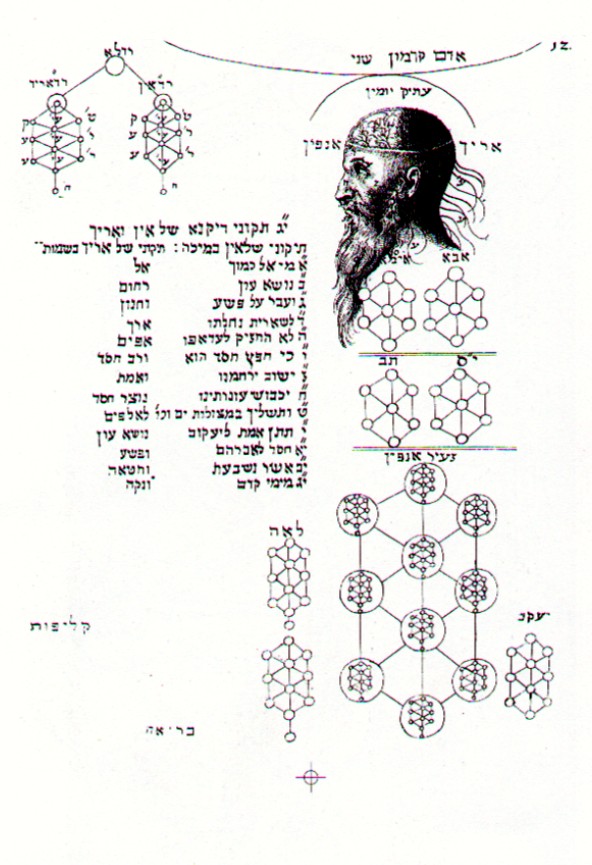
We spent the evening studying the personal journal of Chayyim Vital, a kabbalist and student of Isaac Luria from the late 16th century (WIki here:) and reviewing and dissecting the various levels of Souls, Mystical Worlds, Sefirot, Partzufim, etc. The graphic below makes it entirely clear.


All the four worlds are contained in each of the five levels of the soul, and each of the partzufim are contained in each of the four worlds which are contained in each of the the five levels of the soul. To move up in soul levels from lowest to highest, you have to rectify/integrate all of the levels of all of the other parts. Again, a simple visual explanation:


Moving up each of these levels moves you closer to The One (God), until you are about as close to God as a human being can get. 


Fellow classmate Peter said it was like becoming a Jedi. I kept think of Pokemon (thanks, 10-year-old son) and how they evolve from one stage to the next. Also Angry Birds, where to progress to the next level you have to complete all the puzzles of the previous level. In the Soul Game, however, you'd have to complete all the levels with 5 stars, no exceptions. And if you fail a level, you may have to go back to the beginning. With reincarnation -- yup, Jewish reincarnation -- this becomes a long, long process.


For those like me who are pretty darn sure souls don't even exist, these mental gymnastics about it seem like a waste. Reading the journal of Vital is like reading the scribblings of a man suffering from delusions of grandeur. Everyone he meets is a fortune teller who tells him how great he is -- the greatest in his generation. His belief system -- all of this soul-raising -- must feed on the self-centerdness. 


Why, asks the woman of logic and science, do you all have to make things so complicated?


It's Not Like I Expected 


Sometimes I forget the benefits of being an adult student in a completely optional, taking-it-for-fun class. While I am there to learn, I am also there to learn on my own terms and take from the material what I want -- and that might be very different from what's being offered.


As we discussed last night, there is no such thing as a direct transmission of knowledge or ideas from teacher to student. We all have our own perspective and our own interpretive frame from which we cannot escape. What Isaac Luria transmitted to Chayyim Vital; what Rabbi Ben teaches me; perhaps even what God transmitted to Moses... all of the students put their own spin on things. 


Vital interprets Luria
Moses interprets God (oooh, that's a whole other blog post there...)
Susan interprets Rabbi Ben, who interprets Vital, who is interpreting Luria, etc.


I get my own spin, too.

  • As a study of Jewish history, kabbalah certainly offers some of the more interesting characters. Vital is annoying, but fascinating, and how many other journals from the late 1500s have I read? About zero.
  • I'm fascinated by the ways people rationalize their supernatural beliefs, and these guys are experts. Why is casting magic spells and making amulets prohibited in Vital's time? Because we don't have the ashes of the red heifer, of course. Sorry.
  • Even something like kabbalah can be dangerous. I was disturbed by the connection made between ailments of the body and the mystical belief that it's connected, somehow, to the way your soul-work is going, etc. What a terrible burden to put onto people for their physical ailments. You're in pain? You must not be doing X, Y, Z in the spiritual realm correctly. Pshah.
  • The underlying message -- when you strip away all of the religious layers, may still be relevant. I'm working on this one, but a little self-awareness can be healthy, and kabbalah seems to be saying the same thing as Shrek -- we're like onions. Or, if you prefer Donkey, like parfaits. We all have layers. Call them soul layers if you're religious, or psychological layers if you're not, but we've all got them. Why not explore them?


Besides, how could I not love a class where Jedis, Stargate, holograms, holodecks, mind-enhancing drugs and pissing in the temple courtyard all came up for discussion.