These days you can pick your flavor of Avinu Malkeinu. Just see the links below. From Babs to Phish, everyone is singing out "Our Father, Our King."
None of these versions is my favorite.
My favorite, every year, is the version at Neilah, the final service of Yom Kippur. It involves no choirs, no cantorial solos, no complicated arrangements -- just a community pouring out its heart and soul and hunger and weariness together one last time before as the sun sets and the Gates of Repentance swing shut.
When my son balks at coming to Neilah services, I insist. There is no choice here. Yes, you are a man -- we told you so at your bar mitzvah last year -- but it's my job as a Jewish mother to make sure you stand in the middle of this gathering of Jews and feel the reverberations of this melody.
See the open aron kodesh with the holy Torah scrolls inside, dressed in white, unchanging from year to year, shul to shul, scroll to scroll.
Avinu Malkeinu [We are tired]
Avinu Malkeinu [And we are hungry]
Watch the rabbis, tallisim pulled over their heads, lost in the melody, voices strained, calling on the last of their energy to lead the congregation in its plaintive cry.
Avinu Malkeinu [And here we stand] Chaneinu V'aneinu [Hear our voices]
ki ein banu ma'asim [Rising as one]
.
Feel the people next to you swaying and shukling back and forth as they sing on key, off key, in a key all their own. Sing. Move. This is a full-body experience. We feel it in our bones, and it's in our kishkes.
Ase imanu tzedakah vachesed [The sun is setting]
Ase imanu tzedakah vachesed [The gates are closing]
vehoshiyeinu [And we are so very hungry]
This song, this tune, this people crying together is written on my soul, and it will be written on yours, young Benjamin -- but only if you are here. Only if you look, listen, and remember.
9/10/2001 was one of the happiest days of my life. We celebrated Ben's bris at home -- I feel honored to have witnessed my son being brought into the Jewish people and their covenant, and I felt the presence of my grandfathers as we gave Ben their Hebrew names, Chaim (life) and Velvel (wolf).
The mohel gave a wonderful teaching about how it takes just one person to change the world, and each new soul brought into the world has an equal chance of being that one. I was filled with joy and hope for this new little life.
The next morning, 9/11/2001, I woke to what I thought was Bob Edwards reading a fiction excerpt on NPR's Morning Edition.
The first tower had just fallen.
"It's just gone," the on-scene reporter said.
I spent the day cuddling my new baby in the back of our TV room, wondering what kind of world we had brought this precious life into.
But I still remembered what the rabbi said, and I whispered to Ben, "Maybe you're the one."
But just in case he's not, you and I should be "the one" too.
The Jewish New year is around the corner, and it's the time of year when we Jews reflect deeply on the past year, consider what we have done to damage and heal the world and those we share it with, and make plans for the next year.
Why not plan to try and be the soul that saves the world? What can you do in this next year to make a difference? What will you commit to?
May we all do our part to bring peace and wholeness (shalom and shalem) to ourselves, our family, our neighborhoods, our cities, our states, our country, our world.
The Sages state that it is "only at the age of 40 that the disciple is fit to understand properly the thought of his master," for "40 years is the age of wisdom." That is why, in general, the kabbalists prefer to "transmit" their teaching to disciples who are at least 40 years old. In their opinion, at that age the human soul becomes spiritually mature. The Hebrew word 'neshamah,' soul, confirms this; the letters which compose it also make up the words 'mem shanah,' 40 years.
For many years, I've had a non-interest in the study of Kabbalah. I'm not very into mysticism, and if you've read this blog before, you know I'm a skeptic. I don't believe in the supernatural, and I'm a follower of Dawkins, Hitchens and Harris. Theodicy -- why bad things happen to good people -- has always been a stumbling block for me and the answers religion offers just don't satisfy.
I've also, for many years, used the convenient excuse that the study of kabbalah is restricted to those 40 and over. Yeah. That excuse fell by the wayside recently. 40 I now is.
So when our rabbi announced that he was offering a new class on kabbalah, I decided to sign up. I love studying with our rabbi, and I get out of the house every Tuesday night to spend time with other adults, learning something. Besdies, with a title like: Kabbalah: Hidden Truths: The Earth-Shattering Kabbalah of R'Chayyim Vital and R'Nachman of Bratslav, how could I resist?
It's Just Like I Expected
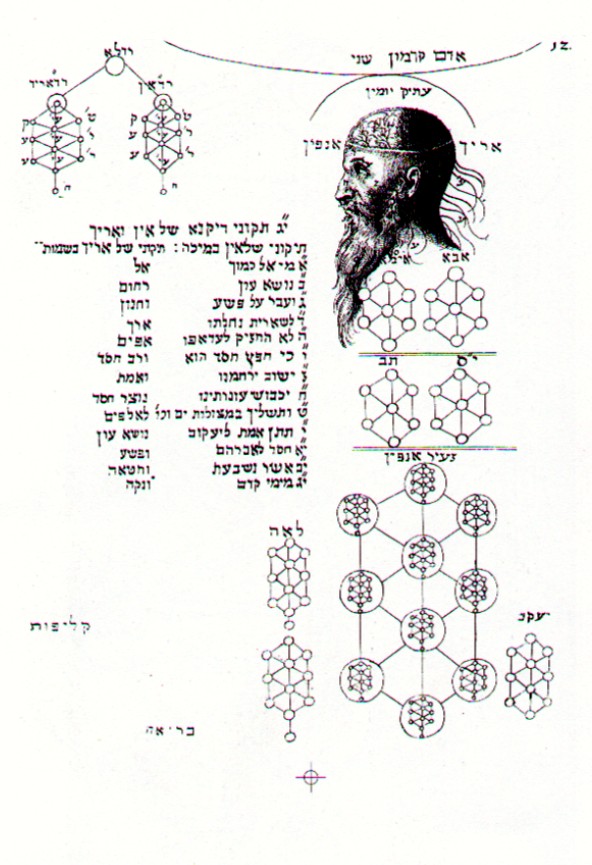
We spent the evening studying the personal journal of Chayyim Vital, a kabbalist and student of Isaac Luria from the late 16th century (WIki here:) and reviewing and dissecting the various levels of Souls, Mystical Worlds, Sefirot, Partzufim, etc. The graphic below makes it entirely clear.
All the four worlds are contained in each of the five levels of the soul, and each of the partzufim are contained in each of the four worlds which are contained in each of the the five levels of the soul. To move up in soul levels from lowest to highest, you have to rectify/integrate all of the levels of all of the other parts. Again, a simple visual explanation:
Moving up each of these levels moves you closer to The One (God), until you are about as close to God as a human being can get.
Fellow classmate Peter said it was like becoming a Jedi. I kept think of Pokemon (thanks, 10-year-old son) and how they evolve from one stage to the next. Also Angry Birds, where to progress to the next level you have to complete all the puzzles of the previous level. In the Soul Game, however, you'd have to complete all the levels with 5 stars, no exceptions. And if you fail a level, you may have to go back to the beginning. With reincarnation -- yup, Jewish reincarnation -- this becomes a long, long process.
For those like me who are pretty darn sure souls don't even exist, these mental gymnastics about it seem like a waste. Reading the journal of Vital is like reading the scribblings of a man suffering from delusions of grandeur. Everyone he meets is a fortune teller who tells him how great he is -- the greatest in his generation. His belief system -- all of this soul-raising -- must feed on the self-centerdness.
Why, asks the woman of logic and science, do you all have to make things so complicated?
It's Not Like I Expected
Sometimes I forget the benefits of being an adult student in a completely optional, taking-it-for-fun class. While I am there to learn, I am also there to learn on my own terms and take from the material what I want -- and that might be very different from what's being offered.
As we discussed last night, there is no such thing as a direct transmission of knowledge or ideas from teacher to student. We all have our own perspective and our own interpretive frame from which we cannot escape. What Isaac Luria transmitted to Chayyim Vital; what Rabbi Ben teaches me; perhaps even what God transmitted to Moses... all of the students put their own spin on things.
Vital interprets Luria Moses interprets God (oooh, that's a whole other blog post there...) Susan interprets Rabbi Ben, who interprets Vital, who is interpreting Luria, etc.
I get my own spin, too.
As a study of Jewish history, kabbalah certainly offers some of the more interesting characters. Vital is annoying, but fascinating, and how many other journals from the late 1500s have I read? About zero.
I'm fascinated by the ways people rationalize their supernatural beliefs, and these guys are experts. Why is casting magic spells and making amulets prohibited in Vital's time? Because we don't have the ashes of the red heifer, of course. Sorry.
Even something like kabbalah can be dangerous. I was disturbed by the connection made between ailments of the body and the mystical belief that it's connected, somehow, to the way your soul-work is going, etc. What a terrible burden to put onto people for their physical ailments. You're in pain? You must not be doing X, Y, Z in the spiritual realm correctly. Pshah.
The underlying message -- when you strip away all of the religious layers, may still be relevant. I'm working on this one, but a little self-awareness can be healthy, and kabbalah seems to be saying the same thing as Shrek -- we're like onions. Or, if you prefer Donkey, like parfaits. We all have layers. Call them soul layers if you're religious, or psychological layers if you're not, but we've all got them. Why not explore them?
Besides, how could I not love a class where Jedis, Stargate, holograms, holodecks, mind-enhancing drugs and pissing in the temple courtyard all came up for discussion.
B'reshit is probably one of the parshas that we all know best. God creating the world in 6 days and resting on the 7th; Adam and Eve; Cain and Abel... The themes have been well-trod by everyone from Joseph Campbell to Shakespeare to Milton to the Moshav Band. I'm not sure I have much to add.
Except for this.
God did not create darkness. "He" created (or separated) the heaven and the earth, and when the separation occurred, the earth was without form and empty...but there was darkness on the face of the depths. And God's spirit moved over the face, through the darkness, before "He" created light.
5 And God called the light Day, and the darkness He called Night. And there was evening and there was morning, one day.{P}
Darkness is something real in our mythology. In the ma'ariv prayer, we speak of God rolling back the light before darkness and the darkness before light.
The latest mass shooting in America took place this past week in Oregon. President Obama said these had become "routine," and he is so, so right. We've all been here before)breaking news, panicked interviews, speculation, confirmation, candlelight vigils. memorial montages and collages, a nonsensical NRA response, the mental health red herring, it's too soon, don't politicize it, do something. For God's sake, do something.
And now we're at the part of the story when the shouting back and forth reaches the same old chant:
Bullets into Flowers. Create Peace.
It's the guns!
It's not the guns!
It's the guns!
It's not the guns!
It's the guns, and it's the darkness. For all of these angry, rage-filled, annihilators, darkness is real. Their view of the world is so warped and twisted and depraved there is no room for light.
They are consumed with darkness, surrounded by darkness, and they feel the darkness as palpable, perhaps much like the Egyptians did when darkness was released as a plague among them. It bleeds into every part of them and escapes as a hail of bullets on their perceived enemies -- those who are in the light.
They prepare themselves for the post-massacre media blitz by taking selfies with their weapons, writing 'manifestos', making confessional videos and amassing arsenals. In life they feel ignored; In death they are notorious. Even if they won't always be remembered, their crimes will. Their darkness spreads to their victims. the murdered, the injured, the families, the schools, the communities, the state, the nation, the world.
What will push back this darkness?
What is the light that will roll into its place?
And who can create it?
I don't have an answer, and I suspect that every person's darkness needs its own unique push-back. One size does not fit all, and some darkness may be too deep to penetrate. We are not gods.
But we can, as God did, create light with our words, and we can bathe in the light of the words of others.
After Sunday School this morning, Ellie and I had our own "Torah Talk." She asked why God had to rest on the 7th day if He created everything by speaking. What's so tiring about that?
As a writer, I had to laugh. If only "creating with words" were that easy.
And as a human being, I know it can be very difficult to create light with our words. "Sticks and stones can break my bones but words can never hurt me" is an outright lie. I don't know about you, but all my bruises from the sticks and stones have healed, but the sting of cruel words, the darkness, can be recalled (and sometimes re-felt) on demand.
Words create, and they are can be powerful weapons or powerful balms.
May we all be blessed to use our words to create light, to help roll back someone else's darkness or our own.
And there was evening, and there was morning. One day.
"Pillars of Creation"
Photograph taken by the Hubble Space Telescope of elephant trunks of interstellar gas and dust in the Eagle Nebula, some 7,000 light years from Earth.They are so named because the gas and dust are in the process of creating new stars, while also being eroded by the light from nearby stars that have recently formed.