Friday, March 03, 2017

Anxiety In, Anxiety Out

It's March 3, 2017, and Donald J. Trump has been president of the United States for 42 days, and it's been (only) 114 days since he won the election. That's not even the length of two Kardashians! The stress and anxiety levels I see in my family, town, religious community, and progressives everywhere have skyrocketed since that fateful day in November.

What stresses me out even more than the presidency, though, is how it's affecting our kids. How we're letting it affect our kids.


We Set the Stage

This has been an amazing two years. The Republican candidates were a train wreck, and no one -- not the networks, not the newspapers, not the people -- could look away from the carnage. "Get a load of this! A reality TV star running for president!" 

In our family, we watched all of the primary debates and followed along daily as Republican candidates fell like dominoes in the face of the Trump machine. It was a laugh. None of these people would stand a chance against Bernie Sanders or Hillary Clinton, so why take it seriously? And the media kept feeding us, long after we were full. 


CNN, MSNBC, and the rest of the networks spent hours broadcasting empty podiums where Trump was going to speak "any minute now." On CNN, Trump received 78% of the coverage between August and September 2015. By November of that year he had received more coverage the entire Democratic field put together.


It was great for the ratings, but bad for the country, one news executive would say post-election.
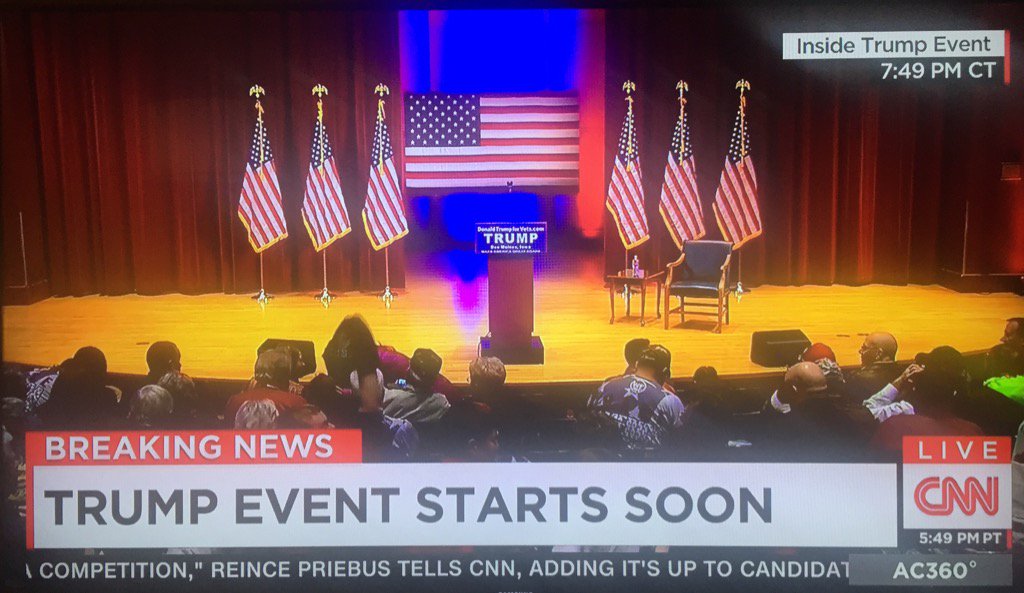


There was nothing else to report while this was on screen?
 It's not "breaking news" that a planned event will start soon, by the way. 

We Stoked the Fear

If you're a progressive, think back to how you talked to your children about Trump between August and November of this year, when he was selected as the Republican nominee and when he won. We presented a Trump presidency in the direst of terms:


  • Armageddon
  • World War III
  • death of the environment
  • cataclysmic
  • the fourth Reich
  • the end of women's rights
  • the end of civil rights
  • Hitler-esque
  • catastrophic
  • devastating
  • impossible

I felt free and justified to use all of these scare-words and more when talking to my kids about the upcoming election. It was a warning bell. He'd never be president, but we have to be on the lookout for these kind of people. They're dangerous, and if they get into power, it will be horrifying. But don't worry. It won't happen, so you have nothing to worry about. 

Then Trump won the election and my role immediately flipped. It was my job (my responsibility?) to make them feel safe. I told them the worst-case scenario couldn't, wouldn't happen, and then it did. I regretted ramping up the fear and began trying to talk it back.

Take Their Point of View
My kids are 13 and 15. Old enough to be aware of the news. but not quite savvy enough to figure out what's an important event, what the media is hyping needlessly, and what is trolling and misdirection. 

They seemed to know every Trump tweet (He went after the cast of Hamilton and SNL!), and if CNN and MSNBC are covering something endlessly, it must be important, even if it's not 100% true. Their social media feeds, usually filled with funny cat pictures and senseless memes, were loaded with dire predictions and fear. 

I'm not saying this fear is unjustified. I could go on for days about the way the Trump administration and the resulting mood in the country makes me nervous and fearful. But why are saddling our kids with those same anxieties?

The Day After


If you're my age, you probably remember the 1983 TV Movie Event, "The Day After".  100 million people watched it, and the media hype around it was intense. From Wikipedia, a summary:
The story follows several citizens – and people they encounter – in and around Kansas City, Missouri and the college town of Lawrence, Kansas, 40 miles (64 km) to its west. 
The film's narrative is structured as a before-during-after scenario of a nuclear attack: the first segment introduces the various characters and their stories; the second shows the nuclear disaster itself, and; the third details the effects of the fallout on the characters. 
During the first segment, as the characters are introduced, the chronology of events leading up to the war is depicted entirely via television and radio news broadcasts, enhanced by characters' reactions and analysis of the events.
It was terrifying. Kids of the 60s don't get to claim all of the nuclear war fear. Yes, you hid under your desks during drills. We watched "The Day After". The film felt especially poignant because I was living in Colorado at the time. Which, as you know, is right next to Kansas and the home of NoRAD, which was prominently featured in "War Games," also from 1983.

We lived in ground zero. It was interesting to watch the people in "The Day After" deal with the fallout, but we knew there'd be no fallout for us, just annihilation.

Looking back on the 80s now, it's easy for me to see, while there was a lot of fear  of a nuclear war, the actual probability was low. Sure, Sting could sing about whether the Russians loved their children, too, but the truth is they did, and no one was truly aiming for mutually assured destruction. Deterrence through strength worked. No one wanted to play the game.


But the media capitalized on our fear. 100 million viewers means a lot of ad revenue for the network and big paydays for the producers of the film. So what if some 11-year-old girl in Colorado was terrified? So what if millions of others were, too?

Our Family's News Blackout

I'm a firm believer in the magic of a playlist. I have dozens of them, each designed to elicit a particular emotional response. Bad day at work and need to rage and pound the steering wheel on the way home? Rage Against the Machine right into Black Flag and Metallica. Need to cheer up? Dispatch to Guster to Bob Marley. Time to cry it out? Avett Brothers and Chris Stapleton every time. Spiritual uplift? JJ Grey, Matisyahu,  and some Mumford and Sons.

It's a little bit of a chicken and egg conundrum -- which comes first, the mood or the playlist? It's a toss-up. I can change my mood by switching playlists, or I can set my mood. Happy song in, happy feelings out. Sad songs in, sad feelings out. Feeling spiritual? Matisyahu magnifies it. 

More than we realize, we have the power to control what kind of energy makes its way into our homes. A few weeks ago we started a News Blackout in our house. No NPR in the background while getting ready in the morning, no CNN pundit roundtables even if Anderson Cooper is a cutie, and no "guess what awful thing Trump did today?" chat at the dinner table.

It's wonderful.

Thanks to Netflix, we watch shows like Parks and Rec, The Office, the new One Day at a Time, and marathons of the British Baking Show. Antiques Road Show is educational and guaranteed never to stress them out. 

We listen to a lot more music, and can spend hours doing down the baby elephant video vortex on YouTube. 

My daughter said last week, "Unless there's a bomb coming, I don't really need to know about it."

My political science major, active citizen side kicked in for a few seconds there. Everyone needs to be an educated citizen! Right? You can't tune out the world! That's how we got into this mess, isn't it? 

Well, no. 

As my son astutely noted, "You adults did this. Kids don't vote."

He's right, and they can tune back in again when they want to. It's always there, 24/7/365. 

Be Kids, Just a Little Bit Longer

Being a teenager is tough enough without adding fear and anxiety about national or even local politics. They need to be focused on school, band practice, painting, their friends, and the joy of letting go, having fun, and playing. 


It's not just our responsibility to keep them safe, it's also our responsibility to make them feel safe. That means filtering out some of the world and not letting it into their lives.They don't benefit from our anxiety, no matter how justified it is. They feed off it and they internalize it. 

I also want my kids to avoid despair and embrace hope. Look for the good in the world. It's there, and there are always people working to help others and make the world a better place, make the arc bend toward justice, however slowly. 


And most important, I want my kids to know this:

I've got you. 


Thursday, December 01, 2016

When is a Swastika a Joke?

I know what you're thinking. A Swastika is never a joke. 

Except maybe when it's on a cupcake. When it's drawn by 14-year-old girls who thought they were being funny.

Maybe.


Delivering Bad News to Jewish Teenagers

Tonight I taught Hebrew High at my synagogue. The topic: A brief history of Anti-Semitism. We talked about the currrent mood in the country, and they shared some disturbing instances of anti-Semitism in their schools.

First, I was heartened to find out that these kids (who are Jewish 8th, 9th, and 10th graders) could not name more than a few negative Jewish stereotypes. When I asked them to brainstorm, they came up with "big noses" and "penny-pinching, cheap and greedy" on their own, but were unaware of the supposed Jewish conspiracy to control the banks, the media, and Hollywood, and they'd never heard of the blood libel

They were shocked to learn some people believe Jews have horns (and sometimes tails!), we had been blamed for the killing of Jesus and the Black Plague, or that Jews were expelled from England, France, and Spain.  The Protocols of the Elders of Zion were a complete mystery to them,  and their only connection to the Pogroms of Russia was the end of  "Fiddler on the Roof". 

I almost felt guilty telling them all of the terrible things that the Jews have suffered over the past 1,000 years. Of lifting the veil. 

But then I remembered that a classmate of my daughter called someone a "Dirty Jew" last week, and another child has had pennies thrown at him in the hall. And that someone painted this on the door of an elementary school in Denver, not all that far from here; 


Our children, our Jewish children, must know that this kind of hate does not have its origins in the Trump campaign, or with the Nazis, or with the Pogroms. Anti-Semitism is built upon a vast, long, and complicated foundation.

The Cupcake
I presented the story of the cupcake in two ways.

Version One: A-14-year old Jewish girl had a birthday party last week, and her friends, who had just learned about the Holocaust, decorated one of the cupcakes with a Swastika.

Their reactions:
"Are you sure they were her friends?"
"I would have punched them."
"Did she make them leave?"
"I bet they're not her friends anymore."

Version Two: A 14-year-old Jewish girl had a birthday part last week and her friends, who had just learned about the Holocaust, thought it would be funny to decorate one of the cupcakes with a Swastika.

Their reactions this time:
"Yeah. Not funny."
"That's different."
"So they weren't doing it to be mean, or hateful. They're just stupid."
"Friends do things like that sometimes. I mean, it's not OK, but it happens."

They had no intention of letting the Swastika-drawing girls off the hook entirely, but they were able to see the crucial difference between my two stories: intent. The intent was for the Swastika to be a joke. An ill-fated joke, and one the girls at the party didn't think through, but a joke nonetheless. 

Through The Children's Eyes
This story received national attention because the mom of the birthday girl wrote a long post about it on Facebook. (You can read the full story here). She linked the cupcake to the current political climate, and she wondered, "Are the lids to human kindness and decency ripped off so permanently that this can happen to YOUR kid in YOUR house?"

My students were not at all surprised that the mom had this kind of reaction and the birthday girl (apparently) didn't. They were willing, once they heard the intent, to give the benefit of the doubt. To see that the act was insensitive but not hateful. To forgive a mistake.

Would they continue to be friends with the Swastika-drawing girls? Yes. If the girls were made to understand why this wasn't a way to joke around, how hurtful it could have been, and what the symbol really represented. My students were absolutely sure that, once they were informed, the girls would never repeat such an act.

I think they're right.

Not Every Swastika is Created Equal
In a follow-up post, the mother reported that the girls had apologized. The mom was clear: "This was not a hate crime," but she was still "pissed off" that it happened. I don't blame her for her anger, and I'm glad she was able to recognize the difference between a hateful act and an act of ignorance that used a hateful symbol. I'm glad my students were able to see the difference as well.

The Anti-Defamation League, in their "Strategies to Confront Bias," suggests the following:
Try to assume good will. Many people who make offensive remarks do so out of ignorance. Because they do not intend harm, they often assume no harm is done.
Should we assume good will of the person who spray painted the Swastika on a school?
Of course not.

Should we assume good will of the kids who throw pennies in the hall, or call another student a "Dirty Jew"? 
No. They are obviously out to bully, but I think it's fair to assume a fair bit of ignorance and to approach these kids as educators and, more important, recognize that they can be educated. 

I'd love the chance to talk to those girls who decorated the cupcake. 
To approach them without blame and with empathy.
To see what was going through their heads when they passed that cupcake to their Jewish friend.
To ask how they feel now.
To encourage them to move forward without shame, and to speak up when they see other friends "joking" in the same way.
To give them the tools to pass on the tough lesson learned.

A Swastika is never a joke... but not everyone knows that. 
Yet. 
Let's teach them.


Monday, March 14, 2016

Send Him to Auschwitz


This guy's been making the rounds on the Internet lately. He seemed to take great pride in throwing up a "Heil" salute and telling a Jewish
reporter to "Go to Auschwitz". (Watch the Video) My come-back quip has been, "That guy couldn't find Auschwitz on a map!" Funny. Ha ha. Ha. How sad is it that I'm probably right?

Talkin bout my Generation

As a Jew raised in post-WWII America I was inundated with Holocaust history from a young age. It wasn't at all unusual to run into someone at the synagogue with a number tattooed on his or her arm. A forever brand of what it could really mean to be a Jew in this world. I read every page of the Time-Life book series on WWII and would wonder which of the living skeletons I would have been? Which way would the Nazi have pointed during my selection? Die Now or Die Later I knew in my gut that I would have been one of them. A child with a yellow star on her coat. A prisoner huddling with her own children in a crowded cattle car. A body in a mass grave dug with my own hands. And I also knew the more difficult truth, that many of my neighbors would have actively participated in my persecution, or turned their backs, or worse, stood silent and watched others do the heavy lifting of evil.


How naive was I to think that the rest of my generation, the rest of my America, was receiving the same education? That they were devouring the same books, watching the same documentaries, staring at the same gruesome photos and wondering
How could this happen?
Why didn't anyone stop it?
The man in the video, raising his hand in a Nazi salute, telling a reporter to "Go to Fucking Auschwitz," is one of the poorly educated that Donald Trump loves so much. Those who don't learn history at all won't even recognize when they're repeating it.

Educate him. Send him to Auschwitz.

I'm not kidding. If not Auschwitz, then the US Holocaust Museum in DC.  

Let them see. Let them learn. Let them stand at the wall of photographs, the piles of shoes, the remnants of normal lives. A pair of glasses. A wallet. A schoolbook. A toy. And let them see also the uncensored photographs. The bodies. The skeletons. The rare color photographs that humanize the victims and make them, unmistakably, human. Then let them come back and see who and what they salute.

Do something.


Never before have I felt the immediacy of this quote:
"In order for evil to flourish, all that is required is for good men to do nothing." -- Edward Burke.
If I do not write. If I do not protest. If I do not use my most powerful tool -- my words -- I am doing nothing. What will you do?

Wednesday, December 16, 2015

This I Believe

Today is my 44th birthday, and assuming that I live into my late-80s, I've reached mid-life, but I find myself, surprisingly, not in crisis. Instead, I've reached an age of competence, confidence, and if one can say it about herself, courage.

I believe the secret to my success has been lowering my expectations and giving up on some goals and dreams. 

I know what you're thinking.


Let me explain.

For years I set goals and made promises to myself (and others) I had absolutely no chance of keeping. 

  • "I will lose 40 lbs in the next 3 months and ride the entire Slick Rock Trail in Moab!"
  • "I will start a blog and publish it every single day!"
  • "I'm going to own a mint condition 1967 Camaro by the time I'm 40!"
  • "I will keep a diary and write in it every day, without fail. My handwriting will be beautiful and I will fill every page with brilliant, poignant thoughts. I will finish each blank book before even thinking about starting a new one."
  • "I'm will set a beautiful Shabbat table and bake challah from scratch every Friday."
  • "I'm will  study the Torah portion and the Haftarah every week and never get bored and skip verses, even the "begats".
  • "I'm going to be more social and host dinners and game nights at my house and have people over spontaneously to just hang out."
  • "I'm going to quit Facebook, Instagram, and Twitter and only read literary fiction and never binge-watch stupid Netflix shows again."


It doesn't take an expert life coach like Yoda to see that I was setting myself up for failure over and over again. I didn't allow for progressive success, and it's almost as if I were setting goals for the person I wanted to be, not the person I am at my core. That list up there isn't really a set of goals and aspirations, it's a checklist of what I thought made a successful, ideal person: athletic, musical, social, cool, diligent, studious, accomplished... perfect. I am some of those things, but I am not and will not ever be all of them.

That recognition and acknowledgment has had some huge side-effects.

I do not envy.
Every single person out there has a quality I don't, an ability I don't, money I don't, or a talent I will not develop. So what?  I've stopped making self-centered, self-focused comparisons in which I always come out the loser. I try not to say: I'll never be able to do that like her and feel like a failure. Instead, I've learned to say: I'll never be able to do that as well as she does, but I am so damn lucky to be in the presence of someone who has those talents, and Wow! Let's celebrate this together!

I give myself breaks. 
I let myself do things that are not goal-oriented or even purposeful. Confession: I love staying in bed until mid-day on weekends and reading, listening to NPR, snuggling with my cat, and reorganizing my shelves. I no longer feel guilty that I'm not on a hike or at the gym or grocery shopping. I sink in, recharge myself, and feel no shame.

I give other people breaks. 
Especially my kids. They're the biggest teachers I've had in this journey to "Okayness." Watching them crash and push and sink into their own natural talents and abilities has made me much more generous with myself. I know that my son, for example, shares my introvertedness and needs time alone to recharge himself and deal with the world. As he has grown old enough to say, "Mom, I want to be alone!" I've grown wise enough not to push too hard against that boundary. 

I ask for help. 
This is a work in progress, but one thing about not having all the talents yourself is that you can ask people with those talents to help you out. Just being able to say, "You're good at this and I suck at this, can you help me?" is a great accomplishment for me. It recognizes the talent in others (easy), reveals my own lack of a skill (difficult), and gets the goal accomplished. Asking a friend to help me make phone calls and plan a social gathering, for example, has always been painful because I'd never want anyone to ask me to do that. But that's not how this work. Me asking a friend to make some phone calls is like him asking me to edit a resume. I'm happy to do it. 

Some people are happy making calls... who knew?

I like what I like, without apologies.
Earlier this year I had a conversation with a friend that went like this.

Me: I really like Ms. So-and-So. She's one of my favorite people.
Friend: Yeah, I don't much care for her.
Me: Hmm. Yeah, um, maybe you're right...
Friend: You can still like her, you know.


Since that conversation I've taken the time to ask myself, "Do I like this because I like it, or because someone else likes it and I want them to think I'm cool and want to fit in?" If it's the latter, it's time to reconsider. 

I forgive.
What I almost wrote to end this piece: "You'd think I would have figured all of this out much earlier in life."

But I'm going to be more generous with myself and end this way instead:

It's OK that I didn't figure all of this out before the age of 44. Life only goes forward, and I'm ready to kick some ass in the second half.


Monday, December 14, 2015

Supporting our Local Islamic Community, One Bored Teenager at a Time

Last night in Fort Collins, Colorado, a few hundred people gathered outside our local Islamic Center for a candlelight vigil of support and solidarity. Our entire family attended -- me, my husband, our 12 year old daughter and our 14 year old son -- three of us willingly.

We are all Jews in our house, but we are not all faith-filled Jews. We celebrate the holidays, we usually light Shabbat candles and set aside Friday night for a family dinner, and we have lots of conversations about what it means to live a Jewish life without faith, to practice Judaism without God.


When children are young, the holidays don't have much meaning beyond a few parties, craft projects, and the many variations of Jewish holiday foods. They dress up in costume on Purim, open presents on Chanukkah, miss school on Yom Kippur, and choke down matzah during Passover. Living a Jewish life is a series of Sunday School, Hebrew School, and hopping from one holiday to the next, trying each year to guess when they'll fall on the "regular" calendar.


In the darkest days of winter we retell the story of the Maccabees and their fight for religious freedom. We fry up some latkes and talk about the miracle of the oil and play dreidel and tell our children that it was used by Jews to secretly satudy Torah when the government tried to prohibit it.

How awful it must have been, we say, to live in times like that.

Pass the applesauce.


Why is This Year Different from All Other Years?

Donald Trump invaded our Chanukkah this year, and I'm betting a lot of other Jewish families took the time to talk about him around their menorahs. What it means to be a Jew and what it means to celebrate Chanukkah were struck in stark relief this year.

We are all subjected to the rhetoric of Trump and those like him, but it is the Jews who must respond with the most force, the loudest voices of condemnation, boots on the ground.

I thought my kids were feeling the righteous indignation right along with me and felt the obligation to stand up and speak out. I thought they were ready and eager to jump into the fray with me, until the day of the march arrived.

Our 14-year-old wasn't into going.
At.
All.
  • I'll be bored. 
  • It doesn't matter. 
  • What difference does it make if I go or don't go?
  • No. I am not going.
I was disappointed, and surprised. He'd been interested in our political discussions over the past weeks, and I knew he agreed that the anti-Muslim chatter was worrisome. "Jews stand up," we had all agreed, and now was the time to do it. But when a 14-year-old gets it into his head that he does not want to do something, the parents have two choices: Fight or Flight. Pick the battle and fight until someone surrenders, or let it go and live to fight another day.


There was never any question in my mind: The was the hill I was willing to die on. He was going to the vigil. Period.

So we fought, and there were the usual threats, and eventually he capitulated. He may have been mumbling, grumbling, and stomping his feet, but he got into the car when it was time to go.


The Islamic Center of Fort Collins, completed in 2013.
The Moment 

We arrived late to the vigil -- there were no parking places anywhere near the Islamic Center, and even when we drove blocks away, all we saw were people bundled up and walking toward the Center.


We stood at the back of the crowd and listened to the speeches and sang along to a couple of songs about peace/salaam/shalom. It was dark, and cold, but there was warmth to be found in the crowd.

The Islamic Center of Fort Collins was completed in 2013 and is a large, two-story structure. We stood in the courtyard bathed in the light from the Mosque's curtain-less windows. There was a crowd inside as well, watching a simulcast on large TVs.


The view from above -- what the children saw.

Silhouettes in the second-story windows caught my eye, and I saw a group of children -- young boys and girls of elementary age -- looking down on the crowd. Some of the girls were wearing traditional head coverings, and one or two would occasionally raise a smartphone and take a picture of the crowd, of us.

What did it feel like to them to look down on this gathering of mostly non-Muslims, standing in their courtyard, the place where they probably escaped to play when they were restless or bored or had been dragged to the mosque by their own parents.

If this were our synagogue, those would be my children looking down from the window, looking out. What would I want them to see?

I pulled my son close to my side and pointed up to the window.

"Look. Look at those kids. Imagine how scared they might have felt recently. How they might have wondered what people like us thought about them. How do you think they feel now?"

"Safer?"

"If you weren't here," I told him, "this crowd would be just a little smaller. But they can see you. You made a difference."

He threw his arm over my shoulder and gave me a squeeze.

"Yeah," he said. One voice in a chorus.


(Want to know more about Chanukkah? Read here. The main themes are religious freedom, re-dedication of sacred spaces, and celebrating God's (limited) miracle of providing oil for the eternal light in the temple while the people took the required time (8 days) to make more.)