This week's haftarah is all about prophets and miracles, and I'm not quite sure what to do with it. Since it's taken from II Kings, you probably haven't read it. Here's the nutshell.
Miracle I:
An unnamed widow, heavily in debt, is being threatened by her creditors. They want her two sons as slaves in payment for what she owes. Enter Elisha (not Elijah) the prophet, who says, "Well, what else do you have to pay with?" "Nothing. One vial of oil. That's it" Elisha tells her to go borrow as many jugs as she can from her neighbors and pour the oil from her vial into the jugs. She does and -- miracle!! -- the oil flowed enough to fill all the jugs. She sells them, repays her debts, and lives comfortably.
There are some pretty clear kernels of wisdom here:
When you're in need, open your eyes and consider what you already have.
Don't dismiss seemingly small things.
Stretch, stretch, stretch every little thing to its maximum value.
Your friends are probably willing to help you out, but you may have to ask them.
Big jugs are good!
God loves making a little oil go a long way.
Jug matching.
Miracle II:
Elisha traveled through Shunam a lot.This really cool, older couple would always welcome him, and they even built an addition to their house just for Elisha.The couple didn't have any kids, and when Elisha learned this, he blessed the woman that she should give birth to a child in exactly one year's time. Whaddya know? She does!Then it gets weird... A few years later the son complained of a headache and died shortly thereafter. The Shunamit woman laid the lifeless body on the bed in Elisha's designated guest room. Elisha hurried to the woman's home and miraculously brought the boy back to life, like this:
Elisha came into the house, and there was the boy, laid out dead on his couch. He went in, shut the door behind the two of them, and prayed to the Lord. Then he mounted [the
bed] and placed himself over the child. He put his mouth on its mouth, his eyes on its eyes, and his hands on its hands, as he bent over it. And the body of the child became warm. He stepped down, walked once up and down the room, then mounted and bent over him. Thereupon, the boy sneezed seven times, and the boy opened his eyes.[Elisha] called Gehazi and said, "Call the Shunammite woman," and he called her. When she came to him, he said, "Pick up your son." She came and fell at his feet and bowed low to the ground; then she picked up her son and left.
What are we to make of this? The Stone Chumash, produced by Artscroll, an Orthodox publisher, says that the way Elisha heals the child is "an eternal lesson fr those who wish to inspire and teach and inspire Jewish children -- to breathe life into them. A teacher must give himself over to his charges of he hopes to succeed."
That's a pretty big logical leap from the "facts" of the story.
I'm also so uncomfortable with people in the bible who get their problems solved through miracles while the rest of us in real life just have to tough it out, miracle-free. Personally, since I don't believe in miracles that happen as a result of the will of a supreme being, I don't feel left out when they don't happen to me.
If this nameless woman in the scripture is worthy of her bareness being "cured" by a prophet, why not the woman of faith who is desperate to get pregnant in 2015?
If a prophet can bring a child back to life because the family was especially hospitable, what is the faithful mother who buries a child left to think?
In some ways, life is so much easier when it's random and reason-less. It's taken me a long time to come to terms with that, but paradoxically, studying these stories helps the reconciliation.
I cracked open a used book tonight to find this inscription.
The book was published in 2005. Let's assume that Lacey bought it new before giving it to Jill as a gift. I personally would not mind a used book as a gift, but most folks would buy new for gift-giving.
That's ten years ago.
I've got a lot of questions for you girls.
Are you sisters? Friends? Lovers?
Mother and daughter seems unlikely because of the expletive, but it's possible. Not between me and my mother, but between some. Their relationship, whatever it is, is casual enough for Lacey to include not only a swear word, but a smiley face and an exclamation point! And the word love.
So lov-ers, perhaps.
Have they broken up? Was the breakup recent, and I am the first next owner of this text? Or has it been floating from reader to reader, each one as befuddled as I.
Did Jill put the book in a box of belongings she returned to Lacey by dropping it on her doorstep in the middle of the night? Or did she shove it into Lacey's arms as she backed out of their shared studio flat, shocked by Jill's guttural wail: Just! Go!
Was it casually tossed in the "donations" bin long after Lacey/Jill Jill/Lacey agreed to put a little space between them.
Lacey / Jill
Lacey / Jill
Lacey
Jill
Did she, whichever she it was, take one last look at what had been inscribed,
long forgotten,
and try to remember what it was like then.
When exclamation points followed Love You! and not Hate You!
and fucking was an endearment and an invitation,
a promise.
Or did they toss it away together,
shaking their heads and laughing
as one says
"I thought you would like this more. "
That ear pain I wrote about in my last post turned out to be a Eustachian Tube Dysfunction due to a sinus infection. Big words for 'everything in your head is all plugged up,' including my creative flow. I probably exacerbated the entire thing by staying out too late two nights in a row this weekend. (Not sorry.)
Tonight, instead of composing a new blog post, I'm taking my decongestant, my heating pad, and my cat, and I'm going to sleep. At 9:18 pm. (Sorry, and Not sorry)
Instead I offer this poem, written by the great Adrienne Rich in 1974. The last line changed my life. Some day I'll tell you how.
Power, by Adrienne Rich
Living in the earth-deposits of our history
Today a backhoe divulged out of a crumbling flank of earth one bottle amber perfect a hundred-year-old cure for fever or melancholy a tonic for living on this earth in the winters of this climate
Today I was reading about Marie Curie: she must have known she suffered from radiation sickness her body bombarded for years by the element she had purified It seems she denied to the end the source of the cataracts on her eyes the cracked and suppurating skin of her finger-ends till she could no longer hold a test-tube or a pencil
She died a famous woman denying her wounds denying her wounds came from the same source as her power 1974
The amount of pain we can carry with us on our everyday journeys is astounding. Everywhere you go, people are in pain -- physical pain, emotional pain, psychological pain, financial pain. For the past week I've had intermittent jaw/ear pain that makes me want to stab myself in the head with a screwdriver. (I won't.) Then I take some more ibuprofen, get out the heating pad, and it recedes to a dull ache. At times I even forget the pain unless I think about how the pain is gone. Thanks, brain, for that trick.
It's been six weeks since Rosh Hashanah, Day II, when we came together, stood in synagogue and literally knocked on our hearts, banging them open with our fists. We called out our sins, and our pain, and we were surrounded by others undergoing the same process -- releasing the same demons.
We also read "The Akedah," the near-sacrifice of Isaac, from the Torah. Our pain and their pain inevitably mix.
"The Sacrifice of Isaac" by VALDÉS LEAL, Juan de 1657-1659
Why?
For this post, I am not interested in the rabbinical, traditional reasons for including this story in the Torah or highlighting it in our High Holiday services. There are thousands of pages of explication of those ideas. Reading them is kind of like watching player interviews on sports channels:
We're really proud of Abraham. He knew what he had to do and went out and did it.
Abraham needed this adversity/reality check/loss in order to keep him on target/track/goal oriented/focused on what we’re trying to do.
Abraham and Sarah have overcome a lot of adversity. This team shows a lot of character. This team shows a lot of poise. This team shows a lot of pride. This team shows a lot of resiliency. This team shows a lot of heart.
Couldn't have done it without God, man. Could not have done it without God. All praises to Him
A Human Story
Boring lives make for terrible literature. If Adam and Eve never got kicked of of the Garden of Eden, would we care who they were? If Odysseus had a pleasant sailing trip and returned on time and happily to Penelope, would we still be telling the tale? What if Hamlet had just shrugged and said, "Meh. To be."
When we read Shakespeare and other works of literature, we put the characters to our own tests. We question motives, look for symbols, and rant and rave about inconsistencies and dismiss the works completely when they falter.
Torah complicates those interpretations because it contains the founding stories of us. Our people. Our God.
We are stuck with all of it, and there is no tossing it aside. Even if you try -- even if you're a "High Holiday Jew," The Binding of Isaac will come and find you.
Torah is greater than the sum of its parts and greater than us as well. There are prices to pay for holding a book in such esteem. We have to dig deeper.
2 And He said: 'Take now thy son, thine only son, whom thou lovest, even Isaac, and get thee into the land of Moriah; and offer him there for a burnt-offering upon one of the mountains which I will tell thee of.'
3 And Abraham rose early in the morning, and saddled his ass, and took two of his young men with him, and Isaac his son; and he cleaved the wood for the burnt-offering, and rose up, and went unto the place of which God had told him.
6 And Abraham took the wood of the burnt-offering, and laid it upon Isaac his son; and he took in his hand the fire and the knife; and they went both of them together.
7 And Isaac spoke unto Abraham his father, and said: 'My father.' And he said: 'Here am I, my son.' And he said: 'Behold the fire and the wood; but where is the lamb for a burnt-offering?'
9 And they came to the place which God had told him of; and Abraham built the altar there, and laid the wood in order, and bound Isaac his son, and laid him on the altar, upon the wood.
12 And he said: 'Lay not thy hand upon the lad, neither do thou any thing unto him; for now I know that thou art a God-fearing man, seeing thou hast not withheld thy son, thine only son, from Me.'
13 And Abraham lifted up his eyes, and looked, and behold behind him a ram caught in the thicket by his horns. And Abraham went and took the ram, and offered him up for a burnt-offering in the stead of his son.
17 that in blessing I will bless thee, and in multiplying I will multiply thy seed as the stars of the heaven, and as the sand which is upon the seashore; and thy seed shall possess the gate of his enemies;
19 So Abraham returned unto his young men, and they rose up and went together to Beer-sheba; and Abraham dwelt at Beer-sheba. {P}
This story demands an active reader. I encourage you to engage with the it and the story on whatever level you can. Even if you don't know Hebrew. Even if you don't believe Torah is "true," and even if (especially if) it puts your current view or faith to its own test.
Isaac survived The Akedah...but
God never spoke to Abraham again.
Abraham never talked to Sarah again.
Isaac doesn't speak to Abraham or Sarah again.
Sarah died.
So much died.
"Old Man in Sorrow" -- Vincent Van Gogh
Abraham did what he was told, what he thought was the right thing, and he lost all he had gained -- his wife, his son, and his closeness to God.
Alone in the world, he is left to "Lech Lecha" all over again. Get up and go... to a new wife, a new family, and maybe even a new God, one he has not known before.
Try to see Abraham, Sarah, and Isaac as real people.
See them also as an amalgamation of all the Jewish forefathers and foremothers.
See them as us.
My Religious School students often asked me why Abraham didn't argue with God. I don't know.
Is it because Isaac had given his consent?
Is it because Sarah had given hers? Abraham was, after all, told to listen to all that she said, and she was a powerful woman. If she had said, "Abraham, don't do it!" would he have listened? Did she say, instead, "Abraham, you must do it."
Does Abraham have no argument to offer?
Sit with this family in their pain.
Sit with yourself -- the self who goes up to the top of the mountain and has to make a choice.
Think about who we have already tied to the rock.
Who have we sacrificed in service of the higher powers of money, success, work, popularity, peer pressure, and society's concept of "normal"?
What things have we done in the name of God that he would not want his name associated with?
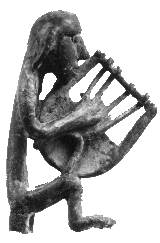
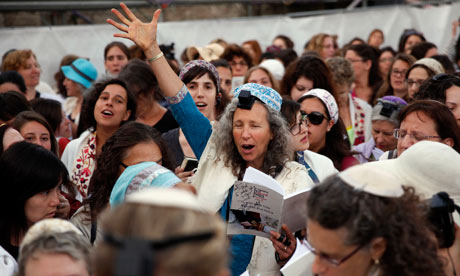
Jews sing a lot. We sing blessings, we sing Psalms, we sing songs of joy, and songs of mourning, and we even sing the Torah. We always have, it seems. Back at the First Temple (destroyed in the year 70 CE) there were specific requirements of the Levites/Priests to sing and play instruments during services.
The entire Torah has a musical score (called trope or cantillation). It's not good enough for us to just stand up in front of the congregation and recite the Torah verses -- we sing them out loud! (I love this site, Navigating the Bible II for looking up specific verses to see how they are chanted.)
I'm sure are volumes of anthropological and empirical evidence for why we humans started transmitting our stories through song. Maybe we were just imitating the birds, or the wind, but it works.
And I would bet that before they figured out complex songs, the early humans figured out humming a soulful tune, desperate to hush a baby's cry.
When I think back on the synagogue services of my childhood, I can't really remember what the rabbis said, or even who they were, but I remember the tunes.
Adon Olam
Ve'ahavta (which is chanted in the same way we chant Torah)
I never really considered myself a spiritual person growing up, and even into my late 20s and 30s. "Spiritual" was always equated to "New Age," and boy did the new-agers of the 80s and 90s ruin that for me. Young Susan was not going to stand in a circle, hold hands with people I didn't know, wear a flowy skirt, and search for something "outside myself". (Honestly, 43-year-old Susan wouldn't do that with a group of strangers either...)
I was always well-rooted in Reform/Conservative Judaism, which at the time didn't include that kind of energy.
We would always sing.
Only sometimes would we sing.
Am I spiritual now? Definitely yes, when live music is involved. I have had amazing, transcendent, soul-lifting and soul-crushing experiences in small clubs, dingy bars, stadiums, arenas, festivals, the greatest outdoor venue on the planet, and the bases of ski slopes.
I have found those moments with bands from Foo Fighters to Phish and Red Hot Chili Peppers to Richard Shindell. I have even found those moments listening to bands whose names I can't remember and probably never knew. Opening acts. Street performers. CAJE conference sing-a-longs at 1 a.m. in a college dorm lounge.
For me, the most salient aspect of these "spiritual moments" is a loss of self-consciousness, which I carry around in droves normally,
Dance Like No One is Watching The closer I can get to that ideal, the more spiritual and authentic the live music experience is.
Introvert Heaven Concerts are the perfect social gathering for introverts. You get to spend time in the presence of lots of other people and have social moments, but you experience the music completely within yourself. And you can move back and forth between interacting with other people or not without judgment. I'm not ignoring you because I'm aloof, or feeling anti-social. I'm ignoring you because the band is playing, man! I am in the groove!
Tonight is Shabbat, and there will be much dancing, singing and rejoicing on the part of this Jew.
At The Aggie,
with Keller Williams
my entire body will be praying.